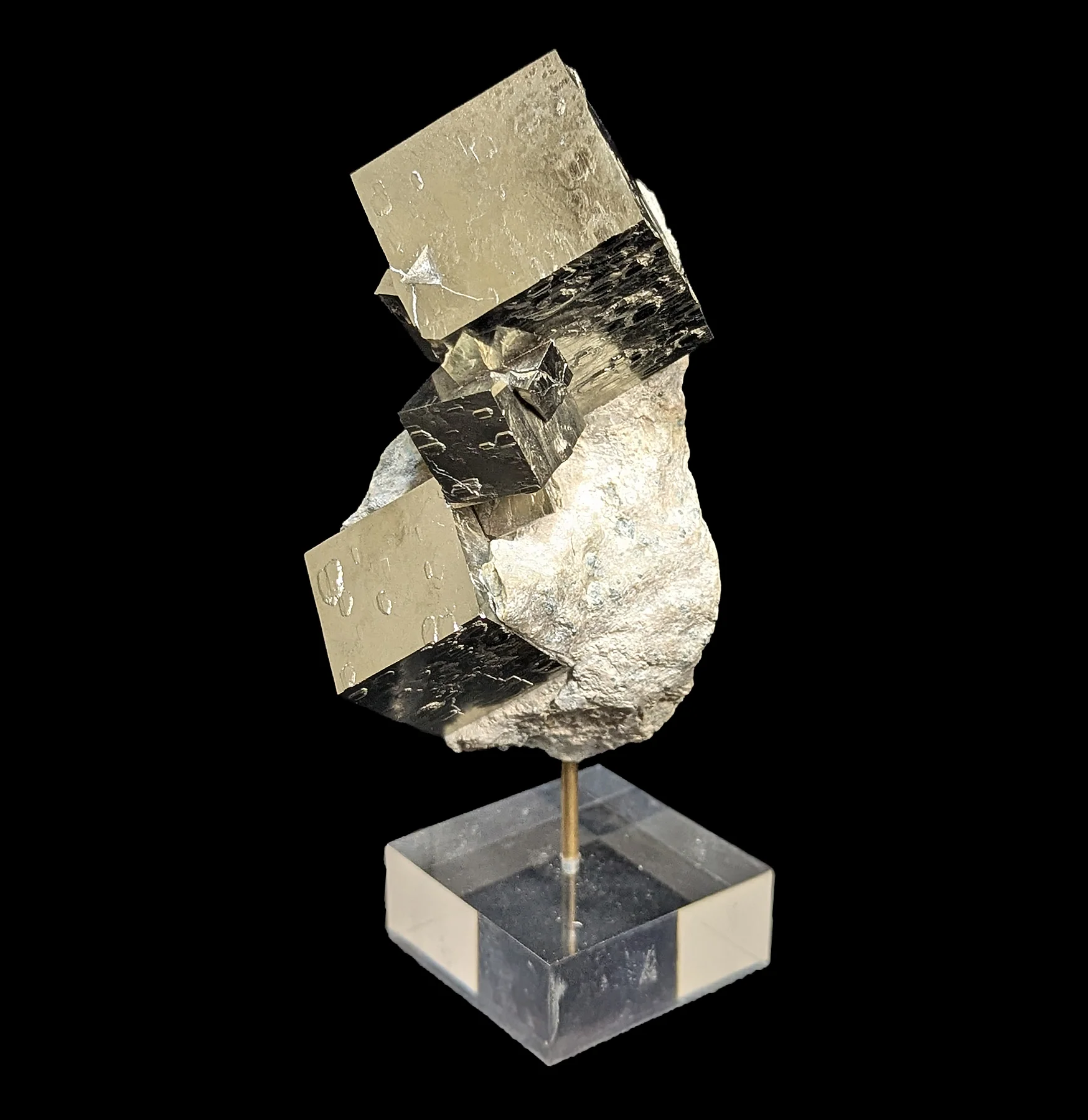
Pyrite Cube on Matrix with Stand Specimen A
One of the coolest things about this specimen is that it’s 100% natural. Yep, you heard that right. These pyrite cubes actually form into these golden cubes all on their own. The internal atomic pattern builds outward in a cubic structure, repeating over and over as the crystal grows. Eventually, that repeating structure produces these perfectly shaped cubes. It’s honestly kind of amazing, and we’re completely enamored with them.
For those of you who don’t know, here’s a little bit about pyrite itself.
Pyrite is a brass-yellow mineral with a bright metallic luster. It has a chemical composition of iron sulfide and is the most common sulfide mineral. It forms at both high and low temperatures and occurs, usually in small quantities, in igneous, metamorphic, and sedimentary rocks worldwide.
Pyrite also has a nickname that has become famous: “Fool’s Gold.” Its gold color, metallic luster, and relatively high specific gravity often cause it to be mistaken for gold by inexperienced prospectors.
The name “pyrite” comes from the Greek word pyr, meaning “fire.” The name was given because pyrite can create sparks when it is struck against metal or another hard material. Because of this property, pieces of pyrite were historically used to produce sparks in flintlock firearms and for starting fires.
According to metaphysical traditions, pyrite has long been valued as a strong protection stone believed to shield the wearer from negative energy and environmental pollutants. Because of this, it is also associated with promoting physical well-being. It is said to stimulate the second and third chakras, enhancing strength of mind and willpower. Pyrite is sometimes considered a lucky stone as well, thought to attract wealth and abundance. Though it is not a birthstone, it is most commonly associated with the zodiac sign Leo.
One of the coolest things about this specimen is that it’s 100% natural. Yep, you heard that right. These pyrite cubes actually form into these golden cubes all on their own. The internal atomic pattern builds outward in a cubic structure, repeating over and over as the crystal grows. Eventually, that repeating structure produces these perfectly shaped cubes. It’s honestly kind of amazing, and we’re completely enamored with them.
For those of you who don’t know, here’s a little bit about pyrite itself.
Pyrite is a brass-yellow mineral with a bright metallic luster. It has a chemical composition of iron sulfide and is the most common sulfide mineral. It forms at both high and low temperatures and occurs, usually in small quantities, in igneous, metamorphic, and sedimentary rocks worldwide.
Pyrite also has a nickname that has become famous: “Fool’s Gold.” Its gold color, metallic luster, and relatively high specific gravity often cause it to be mistaken for gold by inexperienced prospectors.
The name “pyrite” comes from the Greek word pyr, meaning “fire.” The name was given because pyrite can create sparks when it is struck against metal or another hard material. Because of this property, pieces of pyrite were historically used to produce sparks in flintlock firearms and for starting fires.
According to metaphysical traditions, pyrite has long been valued as a strong protection stone believed to shield the wearer from negative energy and environmental pollutants. Because of this, it is also associated with promoting physical well-being. It is said to stimulate the second and third chakras, enhancing strength of mind and willpower. Pyrite is sometimes considered a lucky stone as well, thought to attract wealth and abundance. Though it is not a birthstone, it is most commonly associated with the zodiac sign Leo.
Original: $540.00
-65%$540.00
$189.00Description
One of the coolest things about this specimen is that it’s 100% natural. Yep, you heard that right. These pyrite cubes actually form into these golden cubes all on their own. The internal atomic pattern builds outward in a cubic structure, repeating over and over as the crystal grows. Eventually, that repeating structure produces these perfectly shaped cubes. It’s honestly kind of amazing, and we’re completely enamored with them.
For those of you who don’t know, here’s a little bit about pyrite itself.
Pyrite is a brass-yellow mineral with a bright metallic luster. It has a chemical composition of iron sulfide and is the most common sulfide mineral. It forms at both high and low temperatures and occurs, usually in small quantities, in igneous, metamorphic, and sedimentary rocks worldwide.
Pyrite also has a nickname that has become famous: “Fool’s Gold.” Its gold color, metallic luster, and relatively high specific gravity often cause it to be mistaken for gold by inexperienced prospectors.
The name “pyrite” comes from the Greek word pyr, meaning “fire.” The name was given because pyrite can create sparks when it is struck against metal or another hard material. Because of this property, pieces of pyrite were historically used to produce sparks in flintlock firearms and for starting fires.
According to metaphysical traditions, pyrite has long been valued as a strong protection stone believed to shield the wearer from negative energy and environmental pollutants. Because of this, it is also associated with promoting physical well-being. It is said to stimulate the second and third chakras, enhancing strength of mind and willpower. Pyrite is sometimes considered a lucky stone as well, thought to attract wealth and abundance. Though it is not a birthstone, it is most commonly associated with the zodiac sign Leo.